Training Level 3, day 4


The wind had gone down a lot over the night so it seemed that we would finally be able to fly the spinnaker. We did a theoretical overview on how to hoist, manage and drop the kite. Also, since we had noticed the previous day that our weak spot when doing gybes was the tying and untying of the bowlines when moving the foreguys, we practiced this while on dock. We even made a small competition where we divided in two teams and then one person would tie a bowline, the next person would untie it and so on, passing it around and trying to see which team could end up faster. It was fun and really helpful.

By mid morning we had left Cowes and we started by doing gybes and gybes and gybes until again this manoeuvre was etched in our brains. In the end we were really proficient with it and were able to do two consecutive gybes in less than 4 minutes. Since the wind had died down quite a lot, we had between 10 and 15 knots, we were sailing with the staysail, yankee 2 and full main and the yacht was running fast.

After lunch we finally hoisted the spinnaker. The hoisting went quite well until we only had about two meters to go, at that point it opened prematurely and hoisting these last two meters required a lot of work. After hoisting the spi we needed to drop the yankee and I did a big fuck up, I took out too many turns off the winch and the sail starting dropping too fast. I was able to control it but this could have been dangerous for the people on the bow, I learned the lesson and will be more attentive to how I do this in the future.

Then Mike showed us the best way to trim the spinnaker and we took turns in controlling it and in being at the grinder to grind when needed. Then we did some gybes with the spinnaker flying and most went perfectly, we only wrapped it a little bit in one of them but we were able to unwrap it quite quickly. Gybing with the spi is not very different from gybing with the head sails, the steps are very similar, so it was all very familiar.

The day was coming to an end so we decided to drop the spi. This turned out to be the most difficult part of managing it. Getting it to go through the letterbox and into the cabin took an immense amount of work and needed a lot of people. These sails are so big that anything that you do with them requires a lot of effort.

Once the spinnaker was all down below we needed to wool it (tie it with little pieces of wool so that it is ready for the next hoist). This again took a lot of time and effort, the sail was all over the yacht and it took us almost one hour to wool it and put it in its bag.

We had gone downwind a long way so we now needed to do a lot of upwind sailing. The sunset was quite beautiful but quite cold. Once the sun had gone down we did a night MOB and it went perfect, we recovered Bob in a very short time and were able to confirm how visible the lights in the MOB and the danbouy are at night. 

We had been sailing almost 12 hours by the time we docked and we were all quite tired so we all skipped the pub for the day, trying to get a good night's sleep before our last day.

Training Level 3, day 3


During breakfast everyone had a worried face, we could all hear the wind howling above our heads. The forecast called for gale force winds and I guess this all made us a little apprehensive. But we need to get used to this as these are the kind of conditions that we can expect during our race.

In the morning we did a review of the procedure for gybing and simulated some gybes while docked. I think I was able to get a very good picture of all the processes involved and it was all quite clear in my mind. We did some additional work on knots, had lunch and departed from the dock.

I volunteered to lead the evolution to hoist the main sail and I think it all went quite well, I just forgot to ask for the backstay runners to be brought forward but otherwise everything went like a charm, I felt really well about this. I think that this is something that everyone should try to do as often as possible, leading an evolution really forces you to try to see the overall picture while also focusing in all the little details.

Then we hoisted the staysail and the yacht was heeling like crazy, we were putting the guardrail into the water. We were sailing in 35-40 knots of wind and it was really difficult to move around, I can't imagine what it must be like to be sailing like this for days on end during the race... It was all pretty exciting and we were all grinning. 

We did a lot more tacks and we ended the day with several gybes. They did not go too badly but we saw several weak spots that we needed to improve, specially the handling of the foreguys which was just taking too much time. It was really impressive to see the people tying and untying the foreguys while being almost immersed in the water. All really exciting stuff.

One thing to note is that the new Spinlock life vests are amazing, much more comfortable than the old ones and much easier to get into. I really love them.

That night we were planning to stay in Cowes so we soon started with all the tasks that need to be done before you can be moored: drop the head sails, drop the main sail, flake the head sails and pass them down below, flake the main, prepare all mooring lines and fenders... a lot of work and probably the part of the day that I like less, we were all pretty tired by that point in time and all these tasks can really wear you down.

After dinner we were all pretty exhausted after an exciting but tiring day, I took a quick shower as I was covered in salt and then we met at the pub where we had a really fun night, the team was working really well together and we were all having lots of fun, a great experience.


Training Level 3, Day 2


I didn't have a good night's sleep, my mind kept thinking about the training, and talking to my shipmates it seems that none of us did really sleep well, I guess we were all anxious to get started. Today it was our turn to be "cookies" (we discussed the issue of the term "mothers" being outdated and not really appropriate in our age, Hannah said that she liked to used Cookies and we adopted this), so we started the day by preparing toast for breakfast. My team mate was Toesie and I really enjoy working with her, she is real fun, attentive and full of good ideas.

After breakfast we did further security talks and took a look at the engine, doing the famous IWOBBLEDU routine. I really like that in the 70s the engine is in its own room, it makes it much easier to access it and to check stuff. We also did a full review of all the MOB procedure and of all the roles and tasks involved.

After lunch we finally left the dock and went sailing. The manoeuvre to get out of the dock was not easy at all but Hannah nailed it, she demonstrated an amazing control of the boat and she would continue to do so in the following days, performing some hair raising movements perfectly executed to the inch. 

On the way out of the dock I was able to say hello to Nano, one of the skippers of the race. He was the AQP for Punta del Este in last year's race and from following their blogs I know that he is a really nice guy, so it was great to be able to greet him.

We hoisted the mainsail with three reefs, the staysail and a storm jib in the place of the yankee. It was quite windy, around 30 knots. These yachts really heel over when there is a lot of wind, so you need to make sure that your sail plan is not overpowered. Even with such a small sail plan we were fully heeled over and sailing fast.

The goal of the day was to do a full review of what we had learned in previous training weeks, specially everything related to tacking. So we tacked and tacked and tacked until the sentence "Ready to tack, Runner back" became etched in our minds. I was feeling a bit rusty and it took me a while to get fully confident in what I was doing.

At the end of the day I got the opportunity to do some helming and I had a great time controlling this powerful yacht. Definitely the helming position is much more comfortable than on the 68s and being able to helm on any of the two sides is really great.

Then we did our first MOB procedure. It all went more or less well, the only issue is that somehow we took a long time to be able to drop the staysail, but we were able to recover Bob in a reasonable amount of time. In fact we were very close to him all the time and had to do several passes until everything was ready to recover him.

While everyone started preparing the boat to go back to the Gosport marina, me and Toesie started preparing our dinner. By the time we docked, dinner was ready and we were able to eat and then do a quick review of the day. Doing the dishes felt like an eternity, this is going to be a real pain when we have more than 20 people on board during the race! A quick shower and an early lie down, with the news that we were expecting really bad weather the next day...

Training Level 3, Day 1


It had been more than three years since I did my Level 2, just before the pandemic hit and broke all our plans. Fortunately I had been able to do the trip to Scotland with Skirr adventures last year, so not everything had been lost. So, finally, it was my turn to do Level 3 and get going again!

I arrived in the Clipper office on Wednesday morning to find it full of people, I had never seen so many people gathered together there! Two Level 3s were starting that morning with 10 crew each. If you add the skippers, AQPs and other staff, that's a lot of people. We eventually managed to get all sorted and got introduced to our skipper and AQP. We were really lucky in that our skipper was Hannah Brewis, one of the skippers for the 2023-24 race and the AQP was Mike Miller, another of the skippers for this race, so we were able to meet two of the potential skippers for the race, which was great. I immediately liked both of them, they were really approachable, great fun and not intimidating at all. And they had a great relationship, full of respect of each other and working brilliantly as a team to lead us.

We were also introduced to Ginés, an Argentinian guy who was practicing for a future training role and which would be helping during all our training. He turned out to be a fantastic guy, really helpful, with a nice sense of humour, always there when we needed him.

I got also introduced to the rest of the team: Jon, Dave, Steve, Toesie, Paul, Sean, Gary, Ella and Stan. They seemed like a really nice bunch of people, all eager to get going.

Mike and Ginés went off to do some final shopping while Hannah led us to the Gosport Community Centre where we were to spend the morning and afternoon doing our Advanced Survival Course. The course was okayish, really well delivered by Hannah, but with a lot of redundant content. Also a lot of what we went through we had already seen in the Sea Survival course on Level 2. So I guess that this course is needed, it is important to emphasise all the security aspects of the race, but I didn't feel like I had learnt a lot of new things. At the end of the course we took a small exam about it but it was really easy, all the answers had been clearly outlined during the course.

Then we had to do the theoretical part of our Crew Assessment which is done at the beginning of each level and it was surprisingly difficult. Not in the content of the assessment itself, it was all things that I knew perfectly but in the way it was presented. The wording of several questions and definitions was very confusing and some of the graphics were not clear at all, with detail that was too small or distracting. So, when you do it, read it carefully and in detail.

Then, around 5pm we finally went to the yachts and did a quick introduction of ourselves and a quick tour of the boat, specially looking into its security aspects like the location of the fire extinguishers. The layout of the 70s is very, very different from the layout of the 68s and I think I prefer it a lot. Down below the accommodation is all in the back, better isolated from the working part of the ship. The galley has a U shape with a lot of working space which makes it much easier to work in it and much easier to use when heeling over. It also helps socialising as everyone is really eating in a big communal area. The only things that I liked less were that in the back near the nav station the ceiling is very low and it is very easy to hit your head and there seemed to be less storage space for the crew than in the 68s.

Up on deck they are also very different. The foredeck is much more open and flat in the 70s, with a lot less tripping hazards. The location of the jackstays is also much more comfortable and convenient. Initially I missed the snake pit of the 68s but soon realised that having all the ropes led to the cockpit is incredibly useful. And the helming position is much, much more comfortable.

Then we continued doing parts of our Crew Assessment like winch handling, where I could see that I was a bit rusty and needed to improve, and knots, where my knowledge was perfect and I was able to do them all without a hitch (pun intended).

We had dinner in the yacht (we had had lunch in the high street near the Community Centre, lunch is not provided) and then went to the pub for a couple of beers. Things were relaxed and we had a lot of fun, this really seemed like a great group of people.

We learned that in this level we would be sleeping every night moored, either in Gosport or Cowes, so we would not be doing watches and we would instead aim to concentrate on the other objectives of the level, so off we went, hoping for a good night of sleep.

Finally it is OUR race!

In the summer of 2019 I saw the Clipper Race depart from St Katherine's Dock in London. One pandemic, one war and three years later it was finally the time to welcome them back so I flew to London for the Race Finish.

The first stop was a meet-up for the 2023-24 crew that the Clipper Race team organised. It was held in the basement of The Fox pub at the Excel complex, near the Royal Docks. We had a lot of fun and I was able to mingle with a lot of the people doing the next race, including Alan, Claire, Paul, Simon, Brian, Sophia, Lucy and many others. Many of them knew about me because I have been very active in our Facebook group page. The questions that everyone was asking were "what legs are you doing?" and "have you done any training?". A lot of the people were round-the-worlders and most people were doing at least a couple of legs, I spoke with very few people who were doing only one leg. And no one seemed to be doing the particular combination that I have chosen, legs 2 and 3.


I also got to meet again a lot of the people in the Clipper Race team, including Della, Kirsty and Jilly. At one point during the evening they did a small talk about our next steps and we received two very welcome pieces of news: the date for crew allocation will be mid to late May and will be announced in a couple of weeks and the dates for training next year will be released by mid September.

During the meeting I also learned that I was not the only one to be a fool and get a hotel near St Katherine's docks, expecting the race to return there. The race returned to the Royal Docks which are a bit further East, near the Excel complex. When you compare this new location to St Katherine's you can see that it is much less glamorous, located in a not very beautiful space, far from everything and not very convenient so I would have much preferred to see them going back to the old spot. Also, you don't get the boats to pass under the iconic Tower Bridge. And it would have saved me a 40 min bus + DLR journey :-)

So next day I met a friend at the Royal Docks around 12:00 when all the festivities began. We took a walk around the compound looking at all the info displayed and speaking with some of the Clipper Race crew. Sir Robin was walking around, talking to seemingly "important" people. And I also saw some of the people that I had met the day before.

The ships were supposed to be there around 1:30pm but they did not finally appear until around 2:30pm. We learned that the Imagine Your Korea yacht had had to stop in Ipswich because they were vey late and would not have been able to reach the Royal Docks in time for the prize giving. Since the ships departed Derry last Sunday I was worried that the time available to get to London was too short and unfortunately that happened to be the case :-(


The parade of sail was really beautiful, the yachts did a couple of rounds passing quite near to the docks, with everyone cheering and applauding. It was a great experience and I loved to see them celebrate their arrival into their final destination. Most crews seemed really happy and celebrating, a few were a bit more subdued. It must have been a really emotional moment for them.

Then it was time to dock and it took them a while because there was not enough space for all of them to be dockside so they had to dock in two rows side by side and it was a bit complicated. All the while you could see very happy reunions, people embracing and a lot of celebration going on.

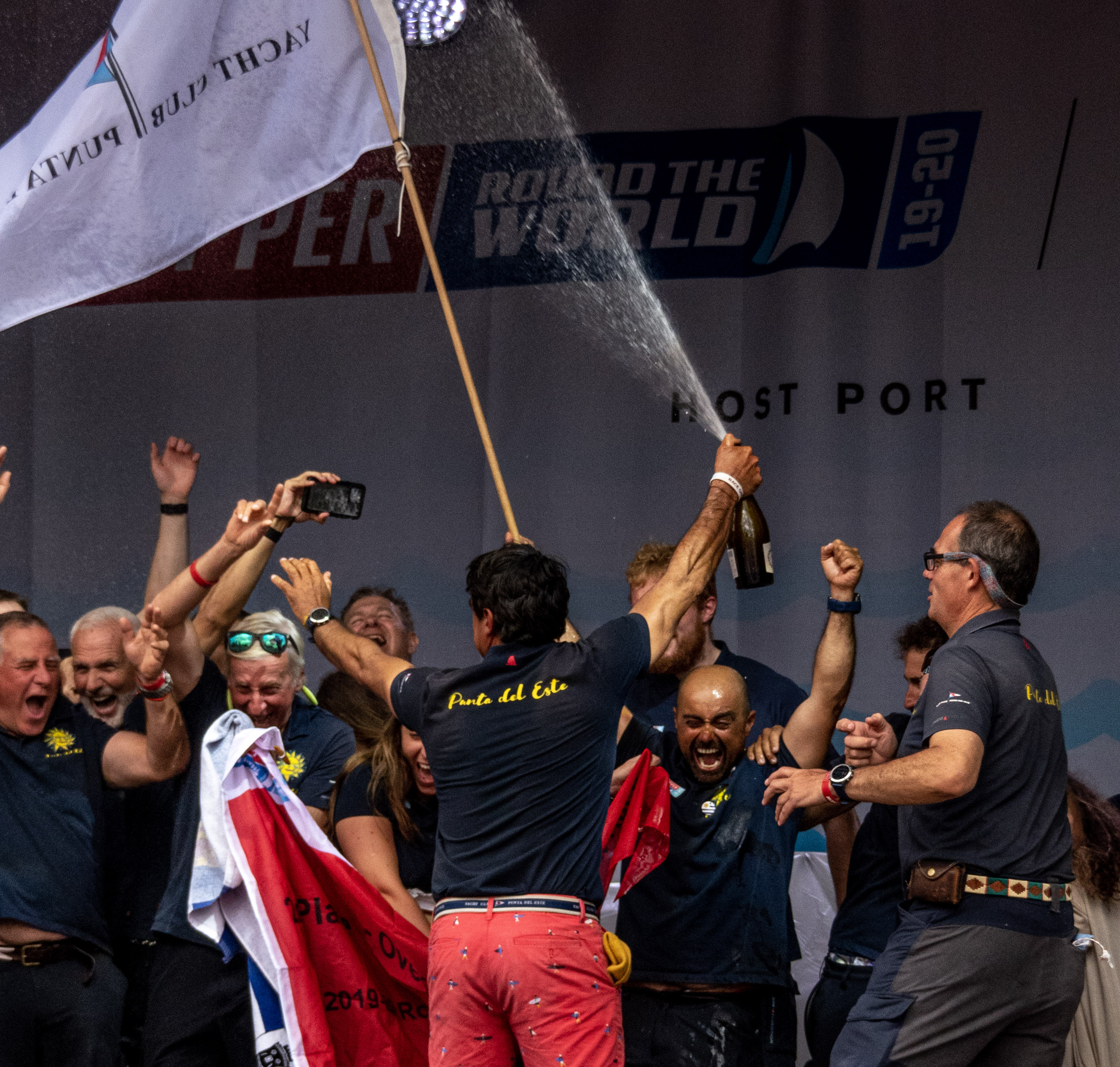
Finally it was the time for prize giving and all the teams walked up near the stage. Sir Robin took the stage and said a few words and then the teams all took the stage one by one, starting with the last one in the classification and ending with Qingdao, the winners. The played each team's chosen music as they climbed into the stage and there was a lot of celebrating, including champagne showers! I was glad to see that the Imagine your Korea team was able to make it to the ceremony even if they had had to leave their boat in Ipswich. You could see that some teams were really happy, jumping around, shouting and having tonnes of fun. Others seemed more subdued, happy but not so exuberant. I want to be part of one of the "happy" teams, jump, shout and celebrate!


It was specially great to be able to see the Punta del Este team, which I had been supporting, take their second place. You could feel their energy and happiness and we had a blast, including everyone singing "Oe, oe, oeeee" and "Vamos Punta!!". I loved it.

During the ceremony I suddenly met Jackie, our first mate from my Skirr Adventures trip at the beginning of the month. She had come to London to see the Race Finish and was going back to Scotland that same day. It was great to see her again!

After prize giving I was able to chat for some minutes with Jeronimo, the skipper of Punta del Este and congratulate him for the great performance of their team. He is Spanish and comes from the same region where I live, so we both had great fun exchanging information. He told me that my choice of doing legs 2 and 3 was great and to prepare for something extraordinary, specially in leg 3. You could tell that he felt very proud about what him and his team had achieved.

And now that the 2019-20/22 race is fully over it is finally OUR time. The "current" race is now the 2023-24 race and there is just a little over a year before our adventure really begins. Everyone told me that the time would really fly now and we would all soon been enjoying this experience that we have all been looking forward to for so long. Can't wait!!

Sailing to Scotland with Skirr Adventures


I had scheduled to repeat my level 2 training in September 2022 but then I learned about the trip to Greenland organised by Skirr Adventures, a company just created by the Clipper group. The trip looked amazing but I did not have the time or the money to do the whole trip, so I decided I might do the first leg, from the south of England to Scotland at the beginning of July. Since this trip was using the same Clipper 68 boats that we use for our training, I decided that doing this trip would provide me a similar experience to what I would get from my repeat of level 2. So I finally signed up for this leg and cancelled my training.

On the morning of the 1st of July we met at the Clipper training offices in Gosport and I was able to meet the crew. The skipper was Bob, a highly experienced Clipper skipper who had participated in a couple of round the world races and done a lot of training with them. He was ex-army and you could tell. Even though he had left the army many years ago you could feel that he still kept a lot of the army spirit and ways of doing things. He was also very opinionated, including thinking that many of the things that Clipper did were nonsense outside of the Clipper race context so it was good to be able to listen to a different point of view. Our first mate was Jacky, a really lovely lady, really knowledgeable and attentive, a real pleasure to work with. And our second mate was Ted, a really young chap but incredibly knowledgeable and fun. I can foresee a great future for him in the professional sailing world.


I also got to meet my mates for the leg: Chris from Northern Ireland, Toni from England, Frank from China, Jeff from Taiwan, Renko from the Netherlands and Trevor from Australia. Most of them had previous Clipper experience, Trevor, Toni and Jeff had been previous circumnavigators and Chris had done one leg in a previous race. Frank was thinking about joining one leg in the next race. The only one who did not have a previous Clipper connection was Renko who had never been involved in any kind of Clipper activity. So we all had knowledge about handling a Clipper boat though for all of us (with the possible exception of Trevor) this knowledge was a bit rusty.

Apart from us there was another bunch of people doing the same trip on another Clipper 68. We did not get to do a lot of sailing together so we mainly met on our stops. They seemed like a decent bunch of people but I did not really get to learn a lot about any of them. The exception was Ewan, the photographer that had joined the trip to document it for the Clipper organisation. He was a really young guy, less than 25 but he had already made a name for himself in the landscape photography world. I spent some time speaking with him and he was a truly remarkable guy, with a very interesting life story.

After some introductory talks about security and a quick man over board drill while still moored we departed around lunchtime on the 1st of July. We also learned from Bob that our mindset would be different from a Clipper race boat: we were not racing, so some of the things that you do on a Clipper boat to sail as fast as possible would not be done here: we would use the engine if needed (though we would try to sail as much as possible), we wouldn't be using the spinnaker a lot, only bringing it out if the conditions were ideal and some of the manoeuvres would be done in a different way that was easier for a short handed crew as ours (most of the time there were only three people on deck). For example, when tacking we would first tack the Yankee and only tack the staysail after the manoeuvre was complete. And the running backstays would be prepared ahead of the tack. In that way you only needed two people (plus the helm) to do the tack.


Our route took us along the south of England through the English Channel, departing the Solent close to The Needles, then sailing along the Dorset coast, then Devon passing Star Point, sailing in front of Plymouth, rounding The Lizard and then Land's End. We then sailed north, passing close to Saint David's,  the Lleyn peninsula and Anglesey in Wales, then continuing closer to Ireland, leaving the Isle of Man to starboard and Belfast to port. We then sailed between the Islay and Jura islands and the Scottish mainland, finally sailing between Mull and the mainland to get to Tobermory.


This took us six days, arriving in Tobermory on the afternoon of the sixth of July. We were able to sail most of the time, we only had to motor through the night of the 4th to the 5th as the wind had died and we wanted to be sure to reach Tobermory before nightfall on the 6th. The wind was quite constant at 15-20 knots most of the time and we did a lot of sailing into the wind, with a lot of close hauled sailing and lots of tacking. We only spent around 20% of our time going downwind.

Initially I felt a bit rusty and at first everything seemed a bit confusing, we all made some mistakes and were slowly getting our knowledge back. But after a few days I again felt very confident and was even able to help some of the less experienced members of the crew. I really love these boats and how they are handled and I think I was able to renew my knowledge and I really think that this trip really was a good alternative to repeating level 2.


The watch system that we used was quite unique, it was a system devised by Bob and it worked like this: We were split into three watch teams and then each team was split in two halves. We would do two 4 hour on deck watches with the full team and then do a 4 hour support watch with just half of the team and then we would rest for one period of 4 hours and another of 8 hours. So it was 8 hours of rest, then 4 hours on deck, 4 hours of support, 4 hours of rest and 4 hours on deck. This was repeated every day so that you were on watch, support or resting the same hours every day. At any point in time there was always a full watch (1/3 of the crew) on deck plus another half of watch on support. While on support you would help in any manoeuvres that needed more people on deck (almost none since we were using this system that allowed us to tack without needing any support) and you would perform "mother" duties: keeping the log, cleaning and general maintenance and preparing meals and hot drinks.

I have to say that this watch system worked brilliantly. The main highlights were:
- Everyday you had a full period of rest of 8 consecutive hours
- The time for your watches, support and rest hours were the same everyday so it was very easy to get used to and very easy on the body which did not need to keep readjusting all the time
- There was no need for a special "mother" watch as these duties would be continuously done by all the support teams
The weak points were:
- There were some teams that had better times than others. I had my 8 hour rest from 8pm to 4am which worked great for me. Other people had it 8am to 4 pm which would not be so nice. But I guess that when doing a long trip you can get used to any timetable and having 8 hours of sleep was a real luxury
- The same people ended up doing the meals all the time. If you were on support during breakfast time you always cooked breakfast, if you were during dinner you cooked dinner, etc... Not sure how this could be avoided
In general I think this worked much better than the 6-6-4-4-4 watch system that Clipper tends to use, so something to think about.


On the evening of our 4th day the wind was perfect for hoisting the spinnaker, downwind with 10-12 knots of wind so we decided to go for it. The manoeuvre went perfectly, we were able to hoist it behind the yankee, then dropped the yankee and it inflated beautifully. I was helming during all of this and I think I did a good job of keeping the boat steady and then following the wind to keep the kite up. It was really amazing to feel the power of this sail and to feel the boat responding to it. Big grins in all our faces!! After a while someone else took the helm and I was able to keep the kite trimmed by using the sheets to keep it properly inflated and not collapsing. I really enjoyed this bit as well.

Then after a couple of hours of sailing with the spinnaker up we decided to lower it because it was getting dark and we did not want to be flying it at night as we were a bit shorthanded for this. We started doing a letterbox drop by releasing the tack and then slowly bringing it in through the mainsheet boom. I was helping to get the kite into the boat and was walking backwards with it bundled in my hands towards the companionway. Big mistake as I was not really looking back so I slipped on something and fell with my back on top of the sail car. It hurt like hell and I had to sit down, catch my breath and stop helping with the drop. After a few minutes I was able to stand up and check that I had not broken anything but I was still under a lot of pain. The next day I was still stiff and was not able to help a lot, I mainly tried to keep as quiet as possible and not do any sudden movements. I hope I have learned the lesson and will always try to look back when walking on deck.
 

On the morning of the 6th day we were finally sailing on our way to Tobermory, passing through narrow channels within the Scottish lands. It was incredibly beautiful, the land was covered by mist and it was all a bit phantasmagoric, I really enjoyed this last bit of the trip and arriving into Tobermory after 6 days at sea was wonderful. We quickly went for a shower and some beers and had a great group dinner at a local seafood restaurant. Tobermory is a really beautiful (and small) place, I really loved it.


Next day was also spent in Tobermory, we talked about the possibility of sailing somewhere but most people preferred to have a day off and do some walking/sightseeing. I had seen some ads for a boat trip to the Staffa and Lunga islands and I decided to join it. It was a bit expensive at £70 per person but it was really worth it. The landscape of these islands is incredible and being able to walk them is awesome. And in the second island we were able to see a huge colony of puffins and to get really close to them. Again an incredible experience that I loved and fully recommend.


Our last day was spent sailing from Tobermory to Oban. It was a beautiful sailing, the sun was up, the wind was in the right direction and we had a lot of fun. Since it was our last day and a short sail we broke the watch system and everyone was on deck. Bob kept telling anecdotes of his sailing experience and we were all having a blast, though a bit sad knowing it was the last day of sailing for some of us. We were all maybe a bit too relaxed as we managed to hoist the yankee upside down! (with the tack and the head interchanged). Bob said that was a first for him! I helmed a lot of the time and was almost able to overtake the other Skirr boat which had departed 10 minutes ahead of us. We did not manage to fully overtake them but we were all in a bit of "racing" spirit, trying to do our best and having fun with it.

The next day we did a quick clean of the boat (we did not do a full clean as we had done a good job of keeping it tidy, so we just did a deep clean of the galley and the heads and a lighter clean of the rest of the boat) and we started saying our goodbyes. We ended this by hoisting Bob up the mast and watching how he did the Spiderman thing while checking that everything was OK up above. I was meeting my wife who had flown from Spain to Edinburgh and was driving to Oban and we stayed in Oban for a couple of days, so we kept bumping into some of the crew and we took the opportunity to share some dinners with them, including a great evening with a lot of wine and Prosecco and really fresh seafood in a local shack. 

So all in all a great experience which was both an amazing sailing trip and a great refresher for my Clipper training and I got to meet a great bunch of people and visit amazing landscapes. I recommend it heartedly. 


Hallelujah!


I have been waiting to write this post for almost two years but finally I am very happy to see that the 2019-20 race has restarted 😀. After being disappointed twice with two postponements I have waited to write this post until I have been able to see the race start with my own eyes. Given the current state of affairs, I would not have been surprised if this had had to be postponed once again due to war in the Pacific, variant ZZZ or the asteroid that finally kills all humanity.

My heart is with the crew of this 2019-20 race, it must have been terrible and very disruptive to have to wait so long to restart this race, I truly wish that nothing else gets in the way and that they are able to arrive safely in the UK by July

And this means that now truly our own race is for real and that in less than two years we will find ourselves doing "the trip of a lifetime". This is really encouraging for me and it will surely help in providing the motivation to continue preparing physically and mentally for this great adventure.

I am really looking forward to again being able to follow the progress of the race through the race tracker and knowing that each day we are getting a bit closer to our dream. Vamos, Punta del Este!!!